4 min read
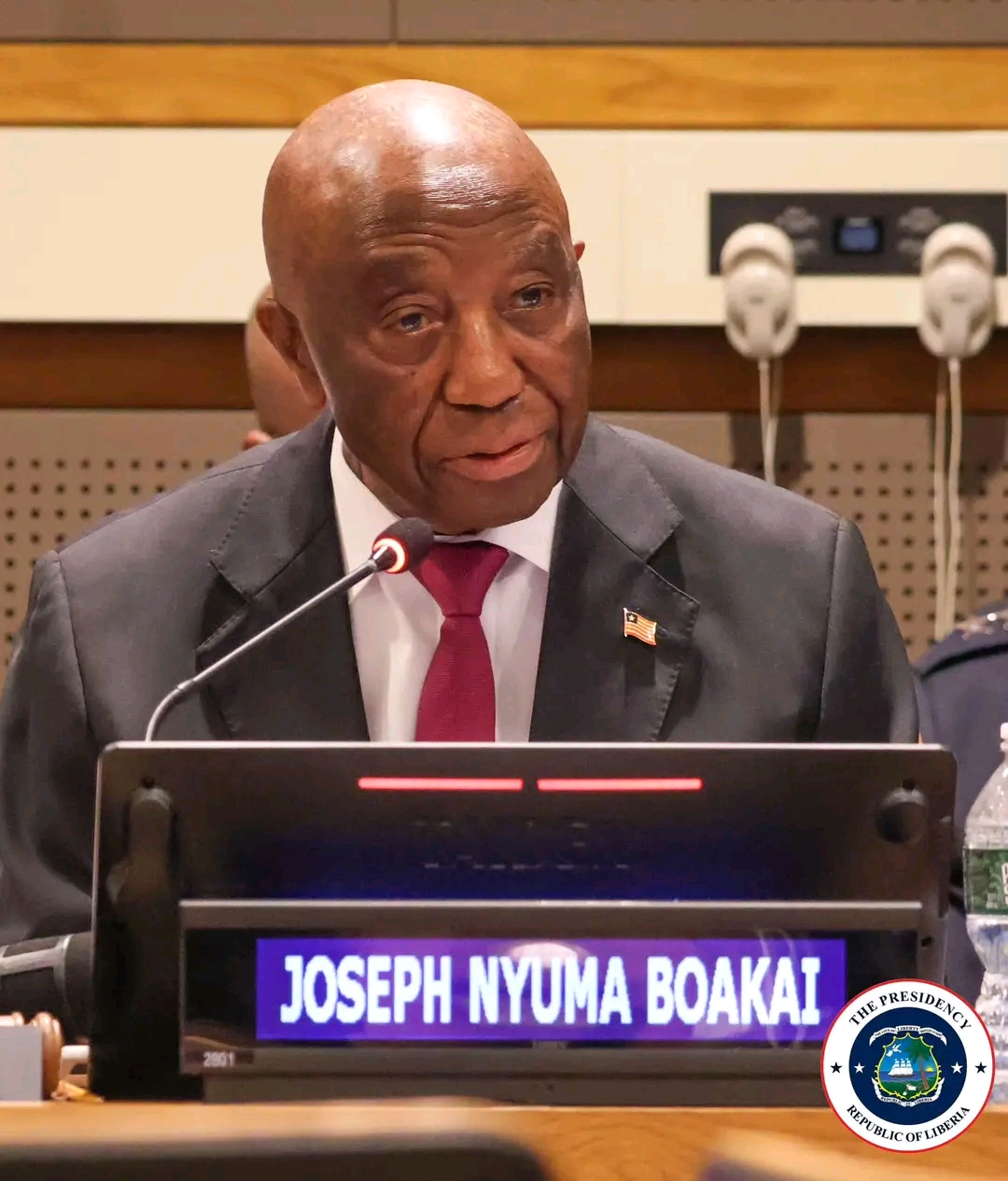
NEW YORK, September 21, 2026 — President Joseph Nyuma Boakai, Sr., on Monday launched Liberia’s Third National Action Plan on Women, Peace and Security (NAP III) at the United Nations Headquarters in New York, declaring that Liberia’s journey from fourteen years on the Security Council agenda to presiding over the Council in December provides a historic opportunity to make Women, Peace and Security a signature priority.
Addressing a High-Level Event on Women, Peace and Security hosted by Liberia in Conference Room 5, President Boakai paid emotional tribute to Liberian women as the true architects of the country’s peace, saying the end of Liberia’s civil war cannot be told without them.
“We have a saying in Liberia, that men make the big decisions while women make the small decisions.
But it is the women who decide which decisions are big and which decisions are small,” President Boakai said in his opening remarks to Excellencies, UN partners, and women gathered at the Peace Hut in Fish Market, Monrovia, who joined virtually.
The President said peace was not only achieved at the negotiating table in Accra, but driven from markets, churches, mosques, streets and communities of Monrovia, where Liberian women refused to be silent.
“The world sometimes speaks of including women in peace as an act of generosity.
Liberia knows better, Women were not merely involved in our peace processes. Liberian women helped build peace,” Boakai stressed.
They were not invited to the peace processes; they made themselves impossible to exclude.”
He recalled the pivotal role of the Women in Peacebuilding Network (WIPNET) and the Liberian Mass Action for Peace, market women, and Muslim and Christian women who mobilized across religious, ethnic and political lines to end the war.
Liberia, President Boakai noted, became the first post-conflict country in the world to adopt a National Action Plan to implement UN Security Council Resolution 1325.
NAP III, launched today, is the third iteration and incorporates lessons learned from past challenges and mistakes.
Framed around Liberia’s ARREST Agenda for Inclusive Development, the President said NAP III is anchored on five pillars:
First, Prevention — addressing root causes of conflict through social cohesion, tackling inequality, challenging harmful norms, strengthening early-warning mechanisms and placing women at the center of violence prevention.
Second, Protection and Access to Justice — including the operationalization of the War and Economic Crimes Court through Executive Order 131 of 2024.
President Boakai said women advocates were instrumental in advancing gender-sensitive justice statutes to address conflict-related sexual violence and gender-based atrocities.
Third, Participation — increasing women’s representation in elected and appointed positions and in the security sector.
The President disclosed that in February 2026, the Armed Forces of Liberia (AFL), in partnership with UN Women Liberia, launched a two-year Elsie Initiative Fund project to remove institutional barriers to women’s recruitment, retention, deployment and leadership in UN peacekeeping.
Liberia’s immediate ambition, he said, is to achieve 15 percent female representation in the AFL by 2028, contributing to a national goal of 40 percent by 2030.
Fourth, Relief, Recovery and Resilience — designing recovery beyond rebuilding infrastructure to restoring livelihoods, dignity and institutions, while addressing new threats including climate pressures, democratic reversals, violent extremism, transnational crime and economic insecurity.
Fifth, Coordination, Accountability and Financing.
With President Boakai directing all relevant institutions, in collaboration with civil society, traditional and religious leaders, women’s groups and international partners, to adopt NAP III as a shared national undertaking.
The President said Liberia will use its non-permanent seat on the UN Security Council to champion preventive diplomacy, locally-led solutions, and its indigenous Peace Hut model as Liberia’s contribution to the global Women, Peace and Security toolkit.
“As a non-permanent member of the Security Council, Liberia does not intend to advocate for women’s participation in peacebuilding around the world while failing to create space for women at home,” Boakai said.
He asserted that a seat is an opportunity, not an achievement. What we do with it is the achievement.”
“Liberia cannot do this alone, and while we seek support to implement NAP III, we are committed to demonstrating the highest level of political will to own it,” the President added, before officially launching Liberia’s Third National Action Plan on Women, Peace and Security.
“To the mothers at the Fish Market who joined us today, your courage changed the course of our nation.
Today, we carry that courage forward,” President Boakai said.