


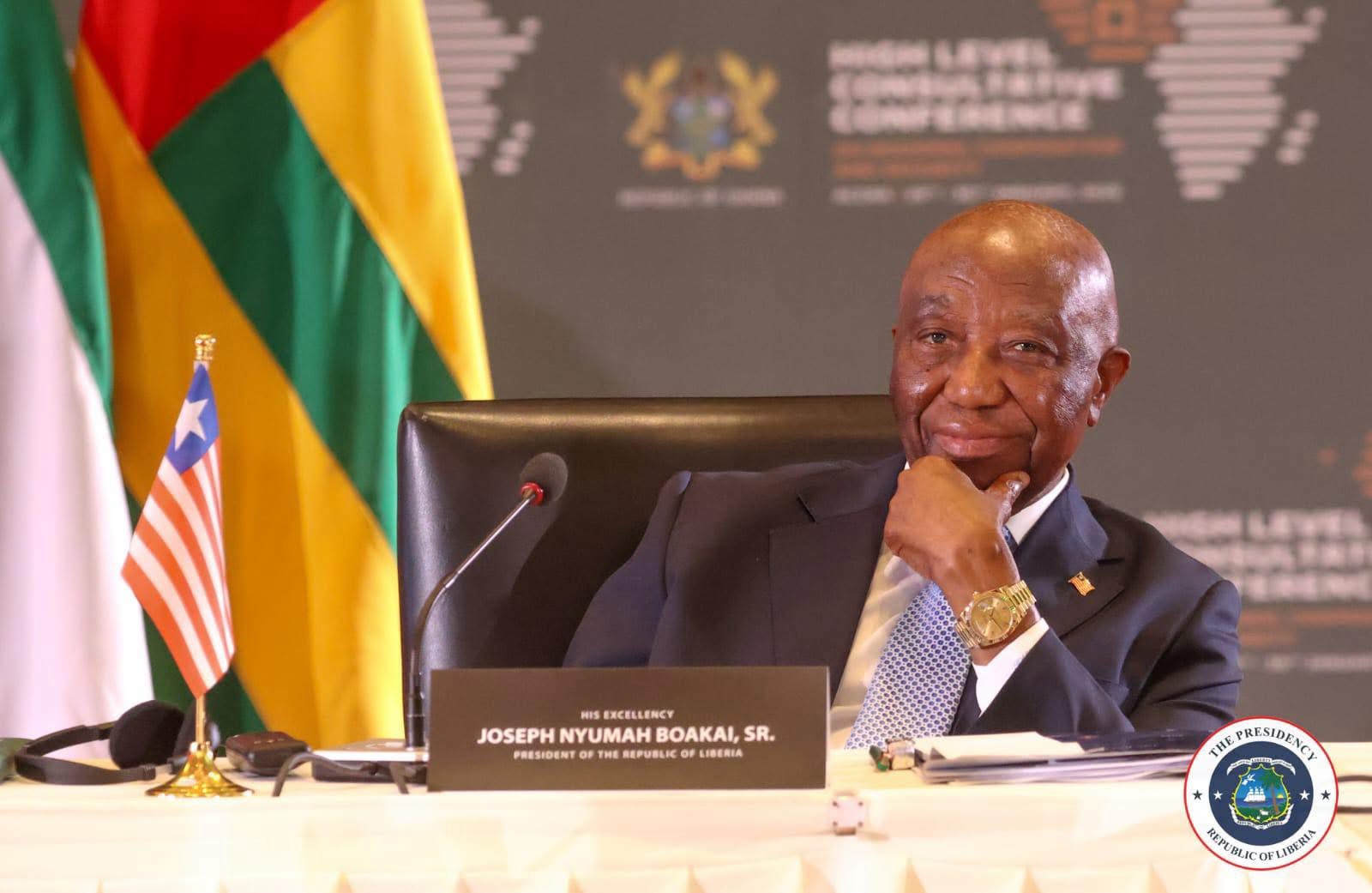
Accra, Ghana – January 30, 2026
President Joseph Nyuma Boakai, Sr. of Liberia has renewed calls for enhanced regional cooperation and collective security, warning that rising insecurity, political instability, and transnational threats pose serious risks to West Africa’s collective survival.
Speaking Thursday at the High-Level Consultative Conference on Regional Cooperation and Security in Accra, President Boakai described recent developments in Niger as a “rude awakening” that underscores the urgency of joint regional action to prevent the spread of violent conflict and instability.
Addressing his counterparts, including Ghanaian President John Dramani Mahama and Sierra Leonean President Julius Maada Bio, Boakai expressed Liberia’s full support for the initiative and thanked President Mahama for convening the conference and for the hospitality extended to participating delegations.
Drawing on Liberia’s own history of civil conflict, President Boakai emphasized that his country understands the devastating costs of war and remains firmly committed to conflict prevention at the national, regional, and international levels.
“Wars and violent conflicts, once started, have no end and no boundaries,” he said, noting that such crises leave nations destroyed and development stalled.
The Liberian leader said the conference comes at a critical moment of global uncertainty marked by terrorism, violent extremism, governance deficits, transnational crime, maritime insecurity, climate-driven resource conflicts, illicit mining, arms proliferation, human trafficking, drug abuse, unemployment, and illicit financial flows.
He also warned of emerging security threats, particularly cybercrime, stressing that increasingly porous borders and daily cross-border movement of citizens require leaders to embrace collective security, regional solidarity, and closer cooperation.
President Boakai expressed concern that growing global polarization and competition are undermining political cooperation and economic integration, with severe consequences for smaller nations. He said these disruptions are contributing to economic decline, unemployment, insecurity, and poverty across the region.
As a non-permanent member of the United Nations Security Council, Boakai said Liberia continues to advocate for a regional approach to peacebuilding and security, arguing that effective responses must involve neighboring states and regional organizations rather than focusing only on crisis epicenters.
“This approach allows us not only to respond to violence where it occurs, but also to dismantle the networks that sustain it across borders,” he said.
The President noted that the Accra meeting aligns with Liberia’s national security strategy and foreign policy objectives, which prioritize regional cooperation as a means of mobilizing resources and pursuing collective action.
He commended intelligence chiefs and ministers of foreign affairs and national security from participating countries for their assessments of current threats and for producing an outcome document with policy recommendations. Boakai reaffirmed Liberia’s commitment to implementing those recommendations in collaboration with other regional leaders.
On socio-economic challenges, he highlighted youth unemployment and rising drug abuse, calling for the activation of existing regional mechanisms to promote economic growth, job creation, education, training, healthcare, and cultural exchange.
In concluding remarks, President Boakai stressed that regional cooperation is no longer optional.
“We are here because there is only one option: our collective survival,” he said. “None of us can be peaceful and stable if any of us is insecure and terrorized. We must act together, and we must act without delay.”
He urged increased investment in regional security architecture, particularly in response to rapid technological advances, to safeguard peace and stability across the subregion.

