3 min read
THE ELEMENTS ARE MISSING”: U.S.-Based Security Expert Alfred Jah Johnson Faults Government’s Case Against Former VP Jewel Howard-Taylor, Says Drug Trafficking and Criminal Facilitation Charges Lack Probable Cause in Public Writ
BY: Rufus Divine Brooks Jr.
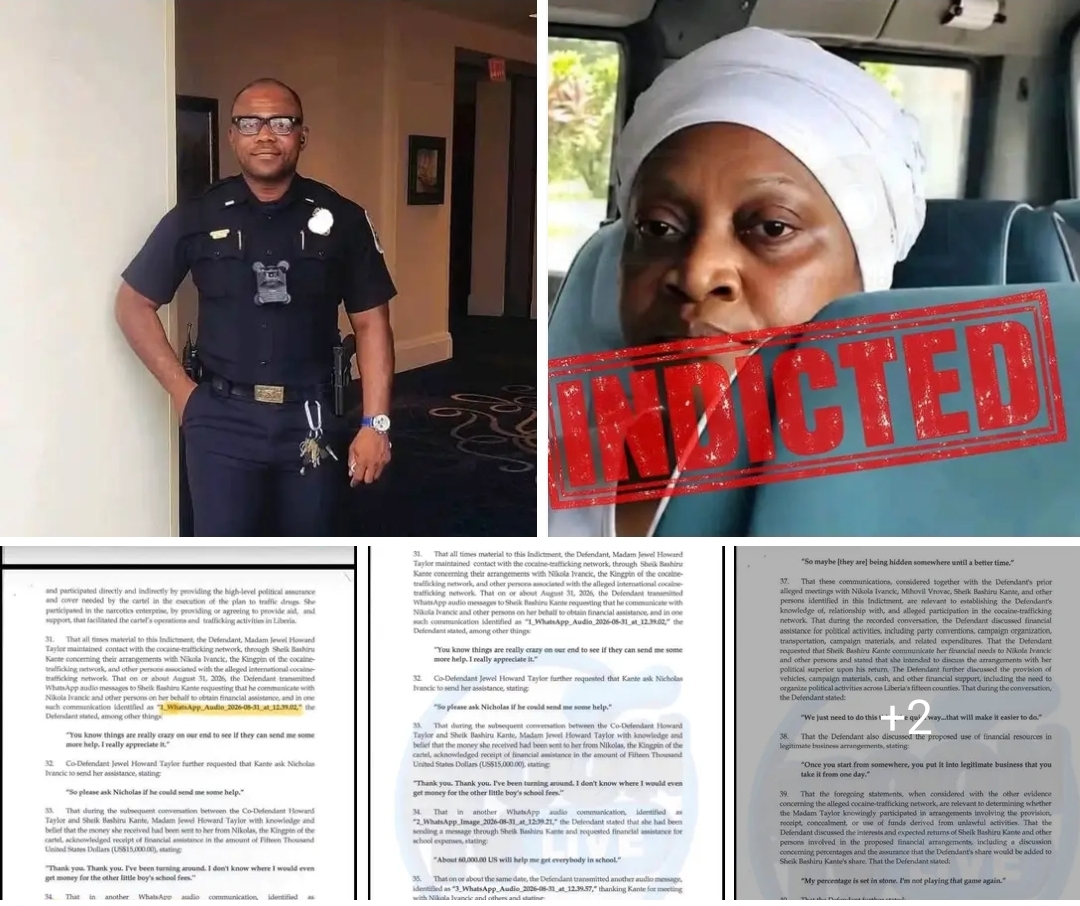
MONROVIA, Liberia — U.S.-based Liberian security expert Alfred Jah Johnson, has raised serious questions about the legal strength of the Government of Liberia’s high-profile drug case against former Vice President Chief Jewel Howard-Taylor, declaring that the elements of the crimes charged have largely not been established in documents made public so far.
In a detailed evidentiary review posted from the United States, Johnson said that based on what is currently in the public domain, the State has failed to meet even the basic threshold of Probable Cause required to secure an indictment.
To illustrate his point, Johnson used a practical example from American policing.
Johnson recounted a case he handled (an example) on October 7, 2026, as Officer Brown #1234 at the Ma Wata Grocery Store on Vamoma House Road and Tubman Boulevard, where a suspect identified as Musa Musa allegedly drank three bottles of Ensure High Protein drink from a six-pack worth $34.50 and attempted to leave with the remaining three bottles hidden in his pockets without paying.
He explained that for a Theft charge to be approved by a judge in a functioning system, the officer must establish four clear elements in writing: taking without prior authorization, intent to deprive the owner, passing all points of sale without paying, and the value of the items.
Without CCTV footage, receipts, and witness testimony to support the sworn Statement of Probable Cause, the charge would be rejected.
At trial, the standard becomes even higher — Proof Beyond a Reasonable Doubt.
Johnson said that when the same legal yardstick is applied to the Jewel Howard-Taylor case, the public filings fall short.
Where are the elements establishing these crimes for which she has been charged?
None of the documents I have seen would have been signed off on by a judge,” he wrote.
He noted that while the full indictment is reportedly over 50 pages and may contain more details not yet public, the excerpts circulating online do not meet the threshold.
Breaking down two of the key charges:
1. Illicit Trafficking in Controlled Drugs (Sec. 14.93 of the 2023 Controlled Drugs and Substances Act): This requires the State to prove that there was a controlled substance, that the accused trafficked it, that the act was knowing and purposeful, and that there was no license for it.
Johnson said the available writ does not list specific actions by the former Vice President that satisfy these elements.
2. Criminal Facilitation: Under Liberian law, this requires proving that another person intended to commit a crime, that the accused believed she was probably rendering aid, that she engaged in conduct providing means or opportunity, that her conduct actually and materially aided the felony, and that the underlying crime was a felony.
Simply talking about it is not enough, Your actions must actually and materially aid the commission of the crime,” Johnson emphasized.
Johnson closed with a lesson from his early career in Prince George’s County, Maryland, where a traffic case he prosecuted was dismissed as “Not Guilty” because he failed to state for the record that the incident occurred in the county — thereby failing to establish jurisdiction.
If it is not said, if it is not written, it did not happen,” he warned.
Johnson stressed he is not declaring the former Vice President innocent or guilty, but that from a professional law enforcement perspective, the government must establish each element of each crime in writing to meet the probable cause standard required for a grand jury to approve charges.
Former VP Taylor remains under detention after Criminal Court “C” Judge Ousman Feika denied her request for bail, citing allegations of continuing conduct through August 2026.