7 min read
PORT HARCOURT, Nigeria — Former Liberian President George Manneh Weah has warned that winning a free and fair election does not authorize a leader to weaken the courts, manipulate the legislature or govern like a dictator.
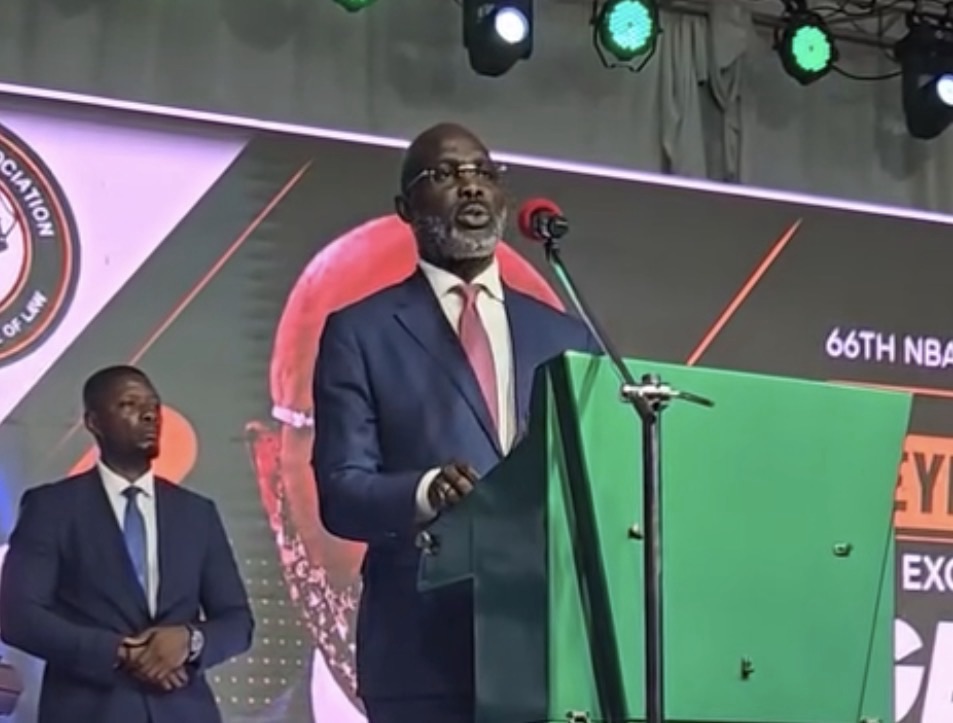
Delivering the keynote address Sunday at the 66th Annual General Conference of the Nigerian Bar Association in Port Harcourt, Rivers State, Weah said democracy must be protected every day through strong institutions, an independent judiciary and respect for the rule of law.
The conference was held under the theme, “Beyond Limits,” with Weah speaking on the topic, “The Bar, the Bench, and the Building of Africa.”
“Democracy does not survive on the strength of elections alone,” Weah declared. “Elections are the doorway into democracy, not the house itself.”
According to the former Liberian leader, democratic systems are threatened not only by soldiers staging coups or defeated candidates refusing to leave office, but also by elected leaders who gradually undermine institutions established to restrain their power.
He cautioned that a leader elected democratically could begin behaving like the dictators the ballot was intended to prevent by pressuring the judiciary and turning the legislature into an “echo chamber” instead of an independent check on executive authority.
“A tyrant with a certificate of return is still a tyrant,” Weah said, adding that democracy does not end on election night but is tested daily by how those in power treat the courts and parliament.
Weah said West African countries must remain alert to both military takeovers and the gradual erosion of democracy under governments that describe themselves as democratic.
He accused some governments across the region of attempting to control the judiciary through budget manipulation, improper appointments, political pressure on judges and the creation of special courts intended to achieve predetermined political outcomes.
The former president also referenced the wave of military coups recorded in West Africa since 2020, describing it as an “unsettling pattern” of soldiers stepping over national constitutions.
He warned that Nigeria, Liberia and other countries in the region must not consider themselves immune from threats to constitutional government.
“A court’s decision must mean what it says, without anyone’s political permission,” Weah stressed. He said respecting judicial decisions protects nations from gradually descending into the same conditions created when soldiers seize power by force.
Weah Defends Early Concession in 2023 Election
Reflecting on Liberia’s 2023 presidential election, Weah said he decided to concede before the final results were formally announced because he believed the will of the Liberian people was more important than his personal political ambition.
Weah said some people around him had advised him to wait and contest every figure until the last vote was certified. However, he said he telephoned Joseph Boakai to congratulate him after provisional results showed the direction in which Liberians had voted.
“I chose to concede while the counting was still underway, because I have always believed, and still believe, that the will of the people must stand above the ambition of any one man in a democratic setting,” Weah said.
He warned that when elections fail to follow democratic principles, the peace and security of a country can be placed in serious danger.
Weah thanked the Nigerian Bar Association for recognizing his decision to concede, saying no political office—regardless of its importance—should be valued above peace or the wishes of the people who granted that authority.
“No office, however high, is worth more than the peace and the will of the people who conferred it,” he said.
Weah Urges Africa to Transform ‘Brain Drain’ Into ‘Brain Circulation’
Turning to Africa’s development, Weah called on governments to move beyond describing the migration of skilled Africans solely as “brain drain.” He proposed what he called “brain circulation,” under which African professionals living abroad would be formally connected to national development without being required to abandon the careers and experience they have acquired overseas.
Weah noted that many highly qualified African lawyers and other professionals have established successful careers in London, Washington, the Gulf region, Paris and New York.
Rather than considering those professionals lost to the continent, he said African governments should build bridges that allow them to contribute their expertise to legal reform, judicial modernization, good governance and economic development.
“A Nigerian-trained lawyer on an arbitration panel in Paris, or advising a global institution in New York, is not lost talent,” Weah said. “It is talent operating at the highest global standard, available to be called home if we organize the bridge for it to cross.”
He said the African diaspora already sends home more than $100 billion annually in remittances and argued that the same energy should be formally directed toward institutional development and nation-building.
The former Liberian president said Africa cannot effectively fight poor governance and economic deprivation while failing to engage a significant portion of its most qualified citizens abroad.
Weah rejected suggestions that Africa’s challenges result from a shortage of talent or intelligence. Instead, he argued that the continent often lacks sufficient infrastructure and the organized political will needed to connect and develop the brilliance of its people.
“We Africans are not short of brilliance,” he said. “We are short, too often, of the infrastructure and the organized will to let that brilliance connect to itself.”
Lawyers Called ‘Sentinels of Democracy’
Weah described the Nigerian Bar Association as more than a professional organization established to advocate for the welfare of lawyers. He called it a “standing sentinel” of Nigeria’s democracy and urged its members to speak collectively whenever the independence of the judiciary comes under threat.
“When the Bar is silent, courts become easier to be captured,” he said. “When the Bar speaks with one voice, as guardians of the bench, the executive branch thinks twice before even dreaming of interference.”
He said the rule of law must guarantee equal protection for every citizen, regardless of political position, wealth or influence. Journalists, traders and students, he argued, should enjoy the same protection under the law as government ministers and military generals.
Weah warned that when confidence in the rule of law weakens, investment, national security, public trust and peace are also threatened.
He urged lawyers to defend people who cannot defend themselves, ensure that due process is respected and apply the law fairly to the rich, poor and powerful.
“True justice is blind,” he said. “It does not know politics. It does not see family or friendship. It knows only the truth.”
Weah said the true measure of a lawyer is not the number of cases won, titles held or money earned, but whether that lawyer has the courage to defend justice and the law when the country needs it.
“The law must never be an instrument of chaos. It must never become a weapon of war,” he said. “It must remain what it was always meant to be: an instrument of remedy, of peace, of unity and of accountability.”
Five Values for Going Beyond Limits
Drawing from his personal journey, Weah recalled growing up in Gibraltar, an underprivileged community in Monrovia, where few imagined that a boy raised largely by his grandmother would become an internationally celebrated footballer, win the Ballon d’Or and later serve as president of Liberia.
“Beyond Limits, to me, is not a slogan. It is a living testimony of my life,” he said.
Weah identified five values that he said individuals and institutions must embrace to overcome barriers: discipline, hard work, respect, perseverance and faith.
He described discipline as the bridge between goals and accomplishment, noting that talent without discipline can undermine success in football, law and public service.
“There are no elevators to success—you must take the stairs,” Weah said while stressing the importance of hard work in confronting corruption, weak infrastructure and institutional inertia.
He urged leaders to respect human dignity, national institutions, diverse opinions and the Constitution. True leaders, he said, do not rise by tearing others down but by lifting people up and protecting the integrity of democratic institutions.
On perseverance, Weah reflected on the elections and football matches he lost before eventually achieving political and sporting success.
“Perseverance is the internal voice that says, ‘I will rise again,’” he said, urging African legal professionals to stand firmly for justice even when political and social pressures are directed against them.
Weah also emphasized spiritual strength, describing leadership as a temporary stewardship granted by God for service to the people.
He concluded by telling members of the Nigerian Bar Association that Nigeria, West Africa and the wider continent depend on them to protect due process, democratic governance and credible elections.
“Nigerians depend on you. West Africa depends on you. Africa depends on you,” Weah said. “Democracy depends on you. And free elections depend on you.”
