3 min read
MONROVIA — As President Joseph Nyuma Boakai delivers his annual Report on the State of the Republic to the Liberian Legislature, Press Union of Liberia (PUL) President Julius K. Kanubah has urged Liberians to critically assess the address beyond routine political commentary, focusing instead on measurable outcomes under the administration’s development agenda.
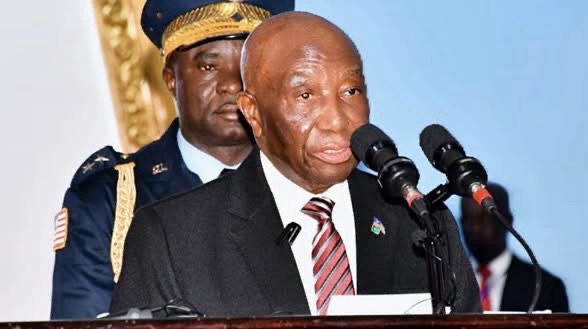

In a detailed reflection released ahead of the President’s address, Kanubah said the speech seeks to answer two fundamental questions: the current state of Liberia and the Boakai administration’s legislative agenda for the year. He noted that the President is expected to frame his report around the government’s ARREST Agenda for Inclusive Development (AAID), which serves as the administration’s overarching policy framework.
The AAID is anchored on six strategic pillars: economic transformation, infrastructure development, rule of law, governance and anti-corruption, environmental sustainability, and human capital development. According to Kanubah, a meaningful evaluation of the State of the Republic must center on what progress, outcomes, or shortcomings the government reports under each of these pillars for the year 2025.
While acknowledging that President Boakai has been in office for two years, the PUL President emphasized that the constitutional report is not a referendum on the administration’s entire tenure, but rather an account of developments over the past year of AAID implementation.
Kanubah challenged analysts, civil society actors, and citizens to interrogate the administration’s performance by asking critical questions, including whether Liberia’s economy has become more competitive and private-sector driven, what modern and climate-resilient infrastructure has been developed, and how effectively the government has strengthened the rule of law, fought corruption, managed natural resources, and invested in human capital.
“Answers to these questions should help inform how we judge the President’s Report on the State of the Republic rather than the usual dismissal that there is ‘nothing new,’” Kanubah said, arguing that state power always produces new realities that demand careful scrutiny.
Placing the current address in historical context, Kanubah described the State of the Republic report as a long-standing ritual of state power in Liberia, dating back to January 5, 1848, when the country’s first President, Joseph Jenkins Roberts, delivered the inaugural report to the legislature.
He referenced historian D. Elwood Dunn’s 2011 publication, The Annual Messages of the Presidents of Liberia 1847–2010, noting that Roberts’ first report emphasized republican governance, agriculture, commerce, rule of law, education, and national prosperity. Kanubah questioned whether similar claims of “substantial and increasing prosperity,” as expressed by Roberts in 1848, could credibly be made about Liberia today.
Drawing further comparison, Kanubah echoed the title of a 2022 opinion piece by former U.S. Ambassador to Liberia Michael A. McCarthy, asking: “What would J.J. Roberts have to say about Liberia today?”
He concluded that President Boakai’s report will ultimately become part of Liberia’s historical record, shaping how future generations judge the condition of the state and the stewardship of its leaders.
Kanubah announced that he would further discuss his analysis of the President’s address during panel discussions on Prime Radio 105.5 FM, airing from 2:00–4:00 p.m. and again from 8:00–10:00 p.m.
