


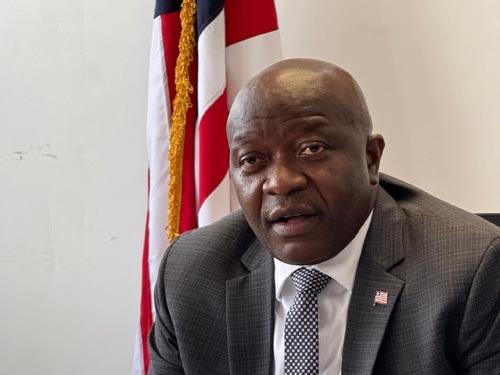
Monrovia — Liberia’s Minister of Finance and Development Planning, Augustine Kpehe Ngafuan, says the country’s economy has grown stronger over the past two years, citing improved growth, low inflation, record domestic revenue, and stronger fiscal discipline despite a sharp reduction in donor support.
Speaking Tuesday during a special press engagement to expand on President Joseph Nyuma Boakai Sr.’s Annual Message, Minister Ngafuan described the President’s address as more than a constitutional obligation, calling it “a national accounting” and a results-based assessment of the country’s progress.
“The central truth of the President’s message is clear,” Hon. Ngafuan told journalists. “Liberia’s economy is stronger today than it was two years ago, and the evidence supporting this is clear.”
According to the Finance Minister, Liberia recorded economic growth of 5.1 percent in 2025, exceeding earlier projections and outperforming the previous year. Inflation dropped to 4 percent, the lowest level in more than two decades, while international reserves increased by 101 million United States dollars. He also noted that the Central Bank of Liberia posted two consecutive operational surpluses for the first time in many years.
Minister Ngafuan said these gains have contributed to a more stable market, improved confidence in the Liberian dollar, and a more predictable business environment.
On government revenue, the Minister disclosed that Liberia collected 847.7 million United States dollars in domestic revenue — the highest in the nation’s history — surpassing its target by more than 43 million dollars. He attributed the performance to tighter controls, reduced leakages, and stronger institutions such as the Liberia Revenue Authority, the General Auditing Commission, the Liberia Anti-Corruption Commission, and the Central Bank.
“These results show that Liberia can finance a greater share of its own development when governance is disciplined and institutions are empowered,” he asserted.
The Finance Minister emphasized that the economic performance was achieved during a period of reduced donor support, a situation that many observers feared would destabilize the country. Instead, he said the government tightened expenditure management while protecting critical sectors including health, education, and infrastructure.
“We did not allow external disruptions to dictate our destiny,” the Minister said. “We kept the country stable, preserved confidence in our institutions, and demonstrated that Liberia can stand on its own feet.”
Addressing criticism that the government is claiming credit for projects initiated under previous administrations, particularly in roads, electricity, and health infrastructure, Minister Ngafuan rejected the notion that development projects belong to political leaders.
“The projects being implemented are not projects for government officials,” he said, citing the regional hospital project that began in 2016 using excess Ebola funds. He explained that successive governments have a responsibility to continue and complete national projects regardless of when they were initiated.
Minister Ngafuan acknowledged that challenges remain but insisted the country is on a better path than it was two years ago.
“We are not yet where we want to be, but we are certainly not where we were,” he said. “Today is better than yesterday. Tomorrow will be better than today.”
He said his engagement with the media reflected a new culture of openness and transparency, stressing that public trust must be earned through data sharing and accountability. The Minister invited journalists to question government policies and spending, noting that progress must be felt in households, markets, and communities across the country.
“Liberia is moving forward,” Minister Ngafuan intimated, “and together we will ensure that the progress outlined by the President is not only seen, but felt.”

