3 min read
Liberia Takes Center Stage at UN Security Council
BY: Rufus Divine Brooks Jr.
Ambassador Brown convenes Secretary-General and elected Council members as Monrovia coordinates both A3 and E10
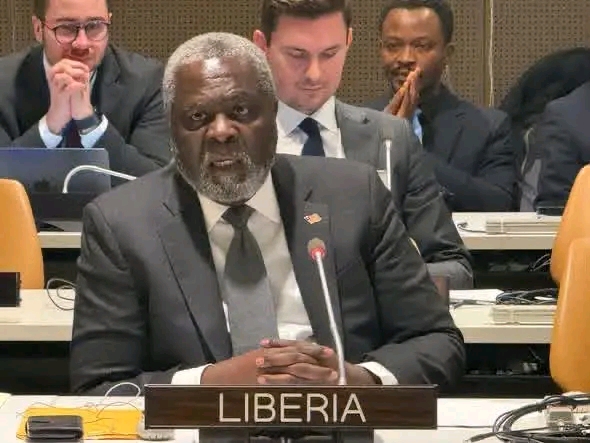
UN HEADQUARTERS, New York — Liberia positioned itself at the center of United Nations diplomacy on Monday, as its Permanent Representative Ambassador Lewis G. Brown II hosted UN Secretary-General António Guterres and the 10 elected members of the Security Council for a working lunch at UN Headquarters in Manhattan.
The engagement was not ceremonial.
With Liberia holding the coordinating role for both the A3, Africa’s three Council members and the E10 — the 10 non-permanent members since August 1, the lunch was designed to align positions ahead of one of the busiest months on the Council’s calendar.
The lunch brought together the E10 which includes Bahrain, Colombia, Democratic Republic of the Congo, Denmark, Greece, Latvia, Liberia, Pakistan, Panama, and Somalia.
Three of those states DRC, Liberia and Somalia also constitute the A3, the group that articulates African priorities inside the Council.
Liberia’s dual coordinating mandate has given Ambassador Brown unusual convening power this month, at a time when the Council is handling crises across the Middle East, Africa, and Europe.
Denmark holds the Council presidency for August.
Ambassador Christina Markus Lassen has overseen mandated briefings on South Sudan, Yemen, Libya, the Occupied Palestinian Territories, DPRK, Syria, and counterterrorism.
The month also includes two signature events: an August 19 open debate on Council working methods, and the August 25 high-level debate on “Food Under Fire” — conflict and hunger.
Diplomats are also monitoring Ukraine, tensions in the Strait of Hormuz, and the planned closure of the UN peacekeeping mission in Lebanon at year’s end — any of which could trigger emergency sessions.
LIBERIA SETS TONE ON MIDDLE EAST AND REFORM:
At the Council’s 10,207th meeting on August 17, Ambassador Brown presented Liberia’s position on the Middle East, warning that prospects for a two-state solution are “rapidly diminishing” due to continued violence, Palestinian displacement, and settlement expansion.
He invoked Liberia’s 1947 vote for UN General Assembly Resolution 181, the original partition plan, to frame the stance as one of long-standing principle.
Two days later, speaking for the entire E10 during the working methods debate, Brown called for reforms to Note S/2024/507.
He urged time-bound leadership of subsidiary bodies after two years of delays in appointing sanctions committee chairs, and pushed for elected members who make up two-thirds of the Council to be included from the start in drafting resolutions, including through shared “penholdership” now dominated by the P5.
As A3 coordinator, Liberia is also steering African positions on Libya, South Sudan, the DRC’s eastern conflict, and AU-led responses in the Sahel and Horn of Africa.
Diplomats say the A3 under DRC, Liberia and Somalia has favored political solutions over sanctions a posture expected to continue through August.
The coordinating role carries added significance because Liberia will assume the Security Council presidency in December for the first time since 1961.
President Joseph Boakai is expected to chair high-level sessions that month.
UN officials described August as a “rehearsal” for that larger task.
Monday’s lunch, they said, demonstrated how Liberia intends to use the presidency by driving direct dialogue between the Secretary-General and elected members, rather than leaving coordination to fragmented channels.
Liberian officials called the engagement consequential both for August’s immediate decisions and for laying groundwork for December.