7 min read
FREEPORT IN CRISIS: AS 700 CONTAINERS SIT FOR 30 DAYS AND MARKET WOMEN PROTEST, NPA BOSS SEKOU DUKULY ANNOUNCES $280M INVESTMENT — BUT QUESTIONS REMAIN
BY: Rufus Divine Brooks Jr.
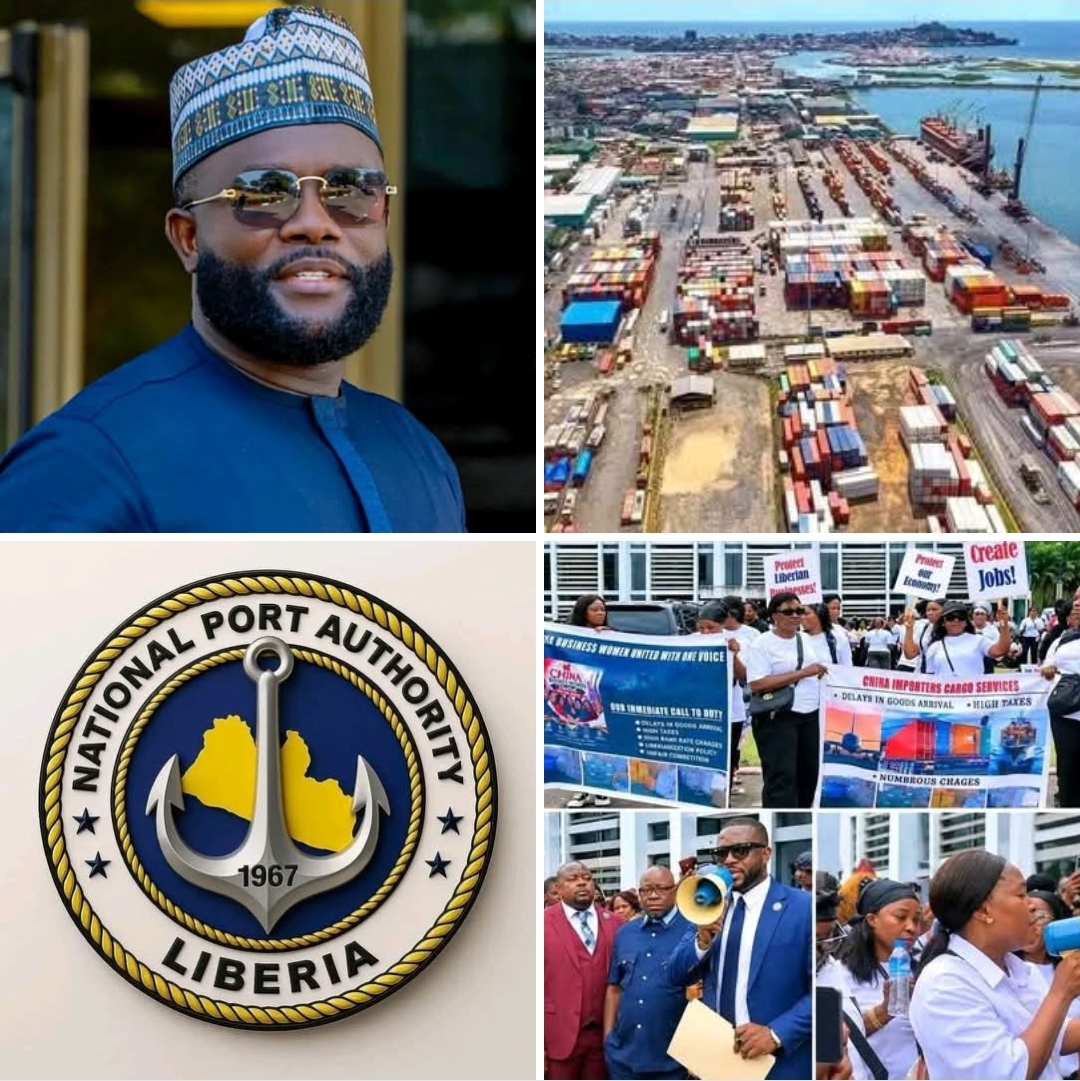
MONROVIA, Liberia — On the beaches of Monrovia this week, the crisis is visible to the naked eye.
At least five cargo ships sit anchored in a line offshore, loaded with rice, cement, medicine, and Christmas goods for Liberian markets waiting for a berth at the Freeport of Monrovia, the country’s main gateway for trade.
On land, the human cost is just as visible, Hundreds of Liberian businesswomen marched on Capitol Hill on Tuesday, demanding that the government act before their businesses collapse.
And at the center of it all is the man in charge of the port: National Port Authority Managing Director Sekou Hussein Dukuly.
Speaking at a press briefing at his Freeport office on Tuesday, Dukuly acknowledged what importers have been saying for months.
The current capacity of the port is low, About 700 containers have stayed at the port for over 30 days a situation he described as “not good” for commerce.
It was a rare public admission from the NPA boss, and it confirmed the core complaint of the business community: the Freeport is congested, slow, and costing Liberians money.
Dukuly said the NPA is working with port users, including APM Terminals and other stakeholders, to improve operations.
According to him, APM Terminals has already ordered additional equipment expected to arrive soon to boost handling capacity.
In addition, the Authority is opening up the unpaved yard to accommodate more containers and allow more ships to berth.
He also announced reforms: the NPA is working with the Liberia Revenue Authority, Ministry of Commerce, CTN, MedTech and other partners to fully automate the port system.
The automation, he said, will allow Import Permit Declarations and other processes to be done online, making the system more effective and efficient and reducing physical delays.
In the most significant part of his briefing, Dukuly revealed that President Joseph Nyuma Boakai has formed the Inter-Ministerial Concessions Committee (IMCC), which has already attracted $280 million in direct capital investment for the port.
The investment, he said, is expected to transform the Freeport of Monrovia into a modern and competitive facility.
Dukuly did not, at the briefing, name the investor, publish the agreement, or provide a detailed breakdown of how the $280 million will be spent, when dredging will begin and end, or when construction will start.
That lack of detail is now fueling skepticism — because Liberians have heard large investment figures before.
A History of Big Announcements, in May 19, 2025, Dukuly announced plans for a $200 million bulk and re-bulk terminal at the Freeport to handle rice, cement, and wheat.
He said Liberia remains one of the few countries in West Africa without a specialized terminal for bulk commodities, an absence that drives up costs.
He also announced a trip to Morocco to initiate Liberia’s first comprehensive Port Master Plan since the end of the civil war.
On October 27, 2025, Dukuly unveiled the NPA’s $550 million Strategic Plan (2025-2030), code-named RESET, at the Ellen Johnson Sirleaf Ministerial Complex in Congo Town.
The five-year plan promised infrastructure modernization, governance reform, efficiency enhancement, financial diversification, inland terminals, and a Port Infrastructure Investment Fund dedicating 15-20% of NPA annual revenue to infrastructure.
One year after that launch, the Freeport is facing its worst congestion crisis in recent memory.
That history does not prove the new $280 million will fail.
But it explains why many importers and lawmakers are now demanding documents, not just announcements.
However, the protest on Tuesday was led by the China Business Women United With One Voice / Consortium of Liberia Importers — women who import merchandise from China and sell it in Red Light, Waterside, Duala, and across Liberia.
They told lawmakers and journalists a consistent story:
Their goods are trapped at sea while bank loans keep charging interest. Demurrage — the daily penalty for holding containers beyond an agreed period — and storage fees are eating their capital.
Some businesses are on the verge of total collapse.
They cannot restock, they cannot repay loans and they cannot feed their families.
Their complaint aligns with a letter sent to the Senate on October 25, 2026 by Gbarpolu County Senator Amara M. Konneh, a former Minister of Finance.
Konneh wrote that importers and shipping agents report that containers bound for Liberia now spend an average of over 30 days at sea before berthing in Monrovia, with most vessels being routed to and held at ports in neighboring Côte d’Ivoire and Ghana.
He identified two main causes: lack of yard space at the Freeport, and prolonged dredging of the port basin and navigation channel, which prevents larger vessels from berthing.
Businesswomen at the protest said some shipments have spent 6 to 7 months at sea before reaching Liberia.
The President of the Shipping Lines of Liberia, speaking at a stakeholders’ meeting in September, warned that vessels have idled in Abidjan for months because of congestion in Monrovia, and that if bottlenecks persist, Liberian businesses stand to lose fortunes — especially with the Christmas rush approaching.
The dredging issue is central to the crisis, and it is not new.
The Freeport’s original design depth was 15 meters.
Dukuly himself admitted in June 2026 it has silted down to about 11 meters.
That 4-meter loss means larger vessels cannot enter fully loaded.
When FrontPage Africa asked Dukuly about the delays last week, his response was: “We are working on dredging and expansion.”
He did not give a timeline or say what the work would cost.
FrontPage Africa’s editorial responded: _”If dredging is the problem, the NPA owes Liberians a public timetable, not one-line assurances.”
In September, Dukuly appointed a Strategic Technical Committee headed by Mohammed Calico Lavalie to untangle the delays and report on bottlenecks from berth to gate.
At a stakeholders’ meeting, Dukuly acknowledged: “Container dwell time has risen beyond acceptable thresholds.
Yard occupancy is approaching levels that reduce operational flexibility, and truck turnaround times are lengthening.
Delays in documentation and release are driving up storage and demurrage costs.”
That diagnosis is correct. What importers want now is a cure with a date.
Konneh’s letter also raised a second issue: cost.
He pointed to a “multiplicity of opaque transaction costs and fees” charged by APM Terminals, MEDTECH Scientific Limited, Global Tracking and Maritime Solutions (GTMS), and other actors in the supply chain.
He wrote: “These delays are severely hurting business inventories, tying up working capital, leading to stock-outs, and imposing heavy demurrage costs.”
In a small, import-dependent economy like Liberia’s, those costs are rarely absorbed by businesses.
They are passed on to shoppers. That, Konneh argued, is a major driver of “sticky prices” — why market prices remain high even as inflation has fallen to 4.6% and the Liberian dollar has strengthened.
APM Terminals, for its part, has told stakeholders that the port was built for transit, not storage.
The free period for consignees is five days, stretched to 14 to accommodate clearance delays.
The operator reported that more than 800 containers are now being discharged within 24 hours, and said improvements are underway.
But when containers sit 30 days, the system has already broken — regardless of who is to blame.
Konneh has asked the Senate to summon port operators and government agencies to appear before the full Senate, sitting as a Committee of the Whole, to explain the delays, high transaction costs, and impact on businesses and consumer prices.
Lawmakers want clarity on four things, the current state of dredging, the berthing and yard capacity problems, the full schedule of fees charged at the port, and the immediate and medium-term steps being taken to clear congestion and reduce costs.
That hearing will be Dukuly’s first test outside his own press briefing — under questioning from lawmakers, in public.
What Dukuly Promised vs. What Remains Unanswered
Promised:
Additional equipment from APM Terminals arriving soon.
Opening of the unpaved yard for more containers.
Full automation with LRA, Commerce, CTN, MedTech.
$280 million in direct capital investment via IMCC.
Unanswered:
Who is the $280M investor? What are the terms?
When will dredging start, and when will the channel return to 15 meters?
How much has Liberia lost in demurrage and diverted trade?
Will importers be compensated for losses caused by delays?
What has been completed from the $550M Strategic Plan?
Will the NPA publish a full, public fee schedule?
Dukuly assured the business community on Tuesday that the current challenges are being addressed and called for continued collaboration to keep Liberia’s main gateway to trade operational.
That assurance may be sincere But for the market women who marched on Capitol Hill, sincerity is not enough.
They need ships to berth, they need containers to move.
They need a dredged channel, a published timeline, and a port that works.
KMTV will be at the Senate hearing and We will follow the $280 million.
We will follow the dredging and We will follow the women.